
When looking for a house to renovate in south Charente or an apartment in Angoulême, the first instinct is often to compare prices per square meter. However, the real estate market in Charente shows considerable differences from one municipality to another, and the criteria for selection go far beyond just price. Understanding recent regulatory constraints and local specifics helps avoid costly mistakes when purchasing.
EPC and diagnostics in Charente: what really hinders a sale
On the ground, it is observed that many transactions in Charente stumble over the issue of energy performance diagnostics. As of January 1, 2025, EPCs carried out before July 1, 2021, are no longer valid. For a seller who has not anticipated this change, it means having to redo a diagnostic even before publishing a listing.
The direct consequence for the buyer: check the date of the EPC before any visit. A property listed with an old diagnostic may hide a reclassification into a less favorable category, which alters the renovation budget and the ability to rent the property afterward.
Since January 1, 2026, renting out properties classified as G is prohibited. In Charente, where the old housing stock is abundant (longères, townhouses, farmhouses), this ban affects a significant portion of properties offered for rental investment. One can browse the available listings on immo-charente.com to spot energy labels and filter accordingly.
The control of diagnosticians has also tightened: a maximum threshold of 1,000 EPCs per year per professional was established in the summer of 2025. This extends the waiting times for obtaining an appointment, especially in rural areas where diagnosticians are fewer. Plan for the EPC as soon as the property is put up for sale, not at the last minute, to avoid delaying the signing.

Real estate prices in Charente: understanding the differences between municipalities
A common mistake is to reason at the departmental level. The IGEDD tracks prices department by department, and Charente (16) is clearly distinct from Charente-Maritime (17). Mixing the two skews any analysis.
Within Charente itself, dynamics vary according to living areas. Angoulême and its first crown concentrate demand for apartments and small townhouses. More rural sectors, towards Confolentais or Charente limousine, show much lower prices, but with longer selling times and a smaller pool of buyers.
Criteria that influence local prices
- The proximity to a road or train station: municipalities connected to Angoulême or Cognac in less than twenty minutes maintain their value better than isolated villages
- The condition of the property and energy class: a house classified as F or G is negotiated down more significantly due to rental restrictions
- The presence of shops and health services: in small towns like Ruffec or Barbezieux, the closure of a medical office or school can dampen demand for a long time
- The seasonal rental potential: areas near the Cognac vineyard attract a tourist clientele, opening up short-term rental prospects
The price per square meter alone is not enough to evaluate a property. This figure must be cross-referenced with the cost of energy compliance renovations, local taxes, and the medium-term resale potential.
Structural diagnostics: a new constraint for old housing
The law of April 9, 2024, created a structural diagnostic for certain collective buildings. A decree published in the Official Journal on August 14, 2025, specified the modalities: the mayor can now require this diagnostic in areas of old or fragile housing.
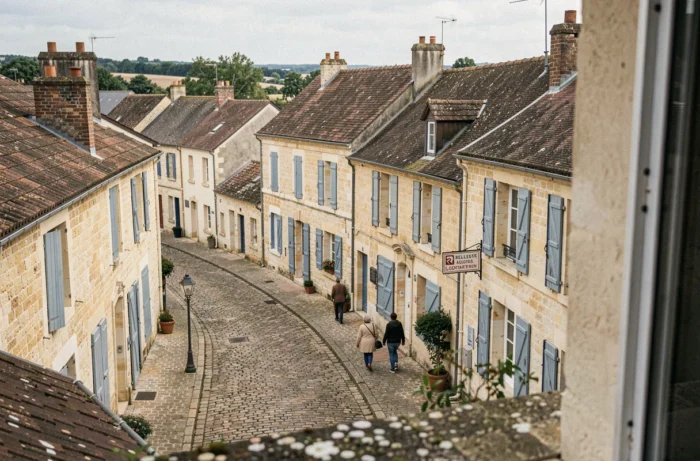
In Charente, town centers have many old buildings in co-ownership, sometimes without an active syndic. A structural diagnostic can reveal hidden issues during a simple visit. For a buyer, this represents both a risk (unexpected repairs) and a protection (knowing what to expect before signing).
Feedback varies on this point: some local professionals believe that this obligation will slow down sales in the oldest towns, while others see it as a market cleansing. In any case, if the targeted property is located in a concerned area, it is essential to ask whether a structural diagnostic has been carried out or prescribed.
Rental investment in Charente: balancing yield and constraints
Rental investment in Charente is attractive for its moderate entry prices compared to the Charente-Maritime coast. Gross profitability may seem appealing, but it is calculated after considering several often underestimated factors.
What gross yield does not reveal
The cost of energy compliance weighs heavily on small old properties. Upgrading a property from G to D (the threshold that guarantees the ability to rent without restrictions in the medium term) represents a significant investment: insulation, heating changes, ventilation. For an apartment in downtown Angoulême, this item can absorb several years of rent.
A rental project in Charente is calculated including renovation costs, not just on the purchase price alone. Areas where rental demand remains strong (Angoulême, Cognac, La Couronne) help limit vacancy, but rents remain moderate.
- Check the current EPC class and estimate the cost of upgrading to at least D or E
- Consult the property tax of the municipality: some small towns have significantly increased their rates in recent years
- Assess the actual rental demand by checking the number of active listings and rental times in the targeted area
For a primary residence purchase, the reasoning differs. Quality of life, proximity to services, and the environment are prioritized, areas where Charente offers a quality-price ratio hard to find in more expensive neighboring departments.
The Charente market remains accessible, but it rewards buyers who take the time to check diagnostics, calculate renovation costs, and compare municipal dynamics before signing. A well-purchased property in Charente is one bought with the right data, not just with good instincts.