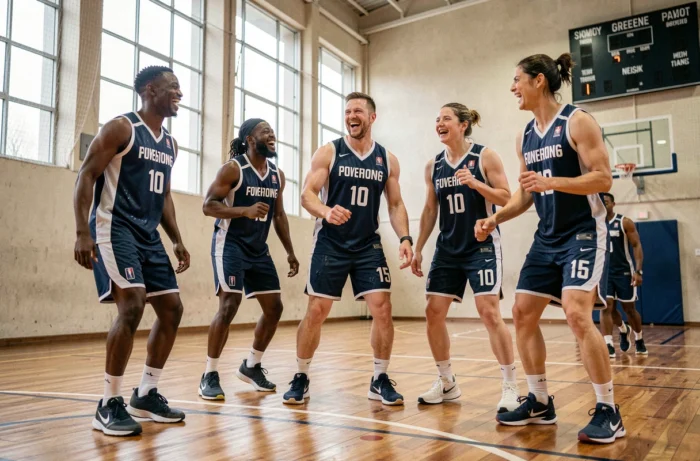
You come back from a handball match or a five-a-side football session, and you sleep better that night. The next day, your mood is more stable, and the tensions at the office seem more manageable. This is not just an impression: team sports affect specific physiological and psychological mechanisms, different from those engaged during solitary jogging. Understanding these mechanisms helps in choosing an activity that is sustainable and produces measurable effects on daily health.
Mental health and team sports: what recent research shows
An observational study published in General Psychiatry in July 2026, focusing on Chinese students, compared five exercise groups. Team ball sports emerged as the most beneficial activity for mental health, showing a clearer association than individual sports across several indicators.
Why this difference? The collective dimension adds an ingredient that the treadmill does not provide: social engagement during effort modifies the hormonal response. The brain releases more endorphins when the effort is synchronized with others. The feeling of belonging to a group also activates circuits related to social reward, amplifying the stress-relieving effect of physical exercise.
In practical terms, playing volleyball twice a week does not produce the same neurochemical profile as an equivalent duration of running. Both are beneficial. One also addresses isolation, a recognized risk factor for depression and anxiety. Resources like Team Sport & Sante help identify collective practices suited to one’s level and constraints.

Effects on sleep and prevention of chronic diseases
The link between physical activity and sleep quality is well documented. What is less clear is the specific advantage of team sports in this regard.
A collective training schedule imposes a fixed timetable, often in the evening or late afternoon. This regularity aligns the circadian rhythm. The body learns to anticipate energy expenditure and then recovery. The result: falling asleep becomes quicker and deep sleep lasts longer.
Cardiovascular and metabolic prevention
Team sports combine phases of intense effort (sprints, jumps) and phases of active recovery (repositioning, walking). This pattern resembles interval training, recognized for its effects on cardiovascular health.
Over the weeks, resting heart rate decreases. Insulin sensitivity improves. The risk of metabolic diseases decreases with regular practice of two to three sessions per week. The fact that the activity is fun and social makes it easier to maintain this regularity than a strict individual program.
Long-term adherence: why people drop out less in teams
You may have noticed that a gym membership often goes unused after a few months? Team sports operate on a different mechanism: mutual commitment.
When a team relies on your presence, missing a training session has a social cost. It’s not guilt; it’s shared responsibility. Research data on adherence shows that group coaching reduces dropout rates among populations that typically disengage.
This phenomenon is particularly observed among three profiles:
- People resuming sports after a long break, for whom the social aspect compensates for initial lack of fitness.
- Young adults exposed to work-related stress, who find in team sports a structured space for decompression.
- Seniors at risk of isolation, for whom the weekly sports appointment sometimes replaces a preventive consultation.
The role of the club in regularity
Joining a sports club, even at a recreational level, formalizes commitment. The schedule of matches or tournaments provides a short-term goal. Progress is no longer abstract: it is measured in collective results, understood tactics, and routines developed with teammates.
Since 2022, the French framework has been simplified to facilitate access to club practice. The medical certificate is no longer systematically required for federal licenses, replaced in many cases by a health questionnaire or a health prevention pathway. The French Athletics Federation adopted this provision starting in September 2024.

Often underestimated physical benefits of team sports
Content on team sports consistently mentions cardio and endurance. However, two physical dimensions often go unnoticed.
Proprioception and reactive coordination
A basketball or football match constantly engages proprioception, the body’s ability to locate itself in space. Changes in direction, evasions, ball receptions: the nervous system processes spatial information in real-time, under opposing pressure.
This engagement improves dynamic balance and reduces the risk of falling, a benefit that matters at any age. The reactive coordination developed in team sports transfers to everyday movements: climbing stairs with a load, catching a falling object, reacting to an obstacle on a sidewalk.
Bone density and mechanical impacts
Team sports involve repeated impacts on the ground (running, jumping, pivoting). These mechanical stresses stimulate bone density, according to a well-known principle in physiology: bone strengthens where it is stressed. Swimming or cycling, weight-supported activities, do not offer this stimulation.
For women after menopause and men over sixty, this factor is not trivial. Practicing a team sport twice a week constitutes a form of active bone prevention, complementary to nutrition.
- Handball and basketball engage both the upper and lower body through jumps and throws.
- Football and rugby concentrate impacts on the lower limbs and pelvis.
- Volleyball combines vertical impulses and shoulder work, with an intermediate impact profile.
The choice of sport depends on the joints one wishes to preserve or strengthen, and the level of intensity one can handle. A discussion with a healthcare professional remains relevant before starting, even if the medical certificate is no longer always required. The best team sport is the one you will still be practicing in six months, because the group gives you a reason to return.