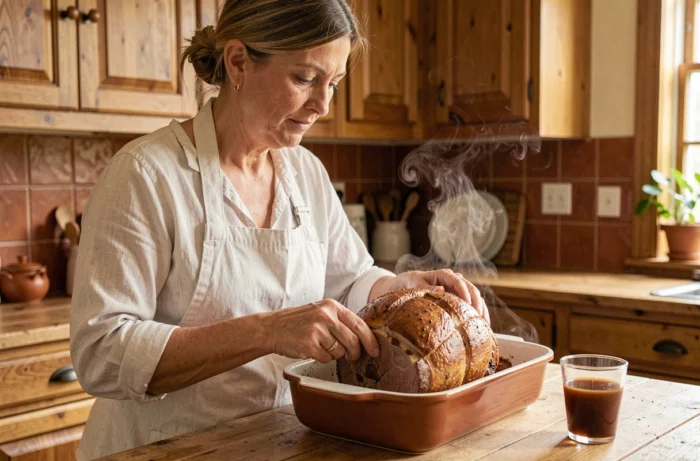
A beef roast prepared the day before, taken out of the refrigerator, loses all the tenderness that was patiently built the first time in just a few minutes in the oven. The problem almost never comes from the meat itself, but from the reheating temperature and the lack of protection against evaporation. Reheating a beef roast without drying it out relies on a few precise, often counterintuitive actions, which we detail here.
Core Temperature and Regulatory Threshold: The Starting Point
Before discussing tenderness, it is essential to establish a constraint that most online guides overlook. French regulations on reheating food require that a cooked and cooled dish be brought above 63 °C at the core in less than one hour. The roast must then remain above this threshold until served.
This rule primarily concerns collective catering, but it provides a useful benchmark at home. Ultra-gentle methods at 50 or 60 °C, popular on blogs, leave the meat in a temperature zone conducive to bacterial growth if held too long. Therefore, we aim for an oven hot enough to exceed 63 °C at the core, but not aggressive enough to recook the fibers.
The only reliable way to check is with a thermometer probe. For several years now, public food safety guides have emphasized the use of a instant-read thermometer to check the core temperature of reheated leftovers. Without this tool, we are working blind. They can be found for just a few euros, and the gain in safety and cooking precision justifies the purchase.
The concrete goal for reheating a beef roast without drying it out can be summed up in one sentence: reach the right core temperature as slowly as possible, while staying within the one-hour window imposed by good hygiene practices.
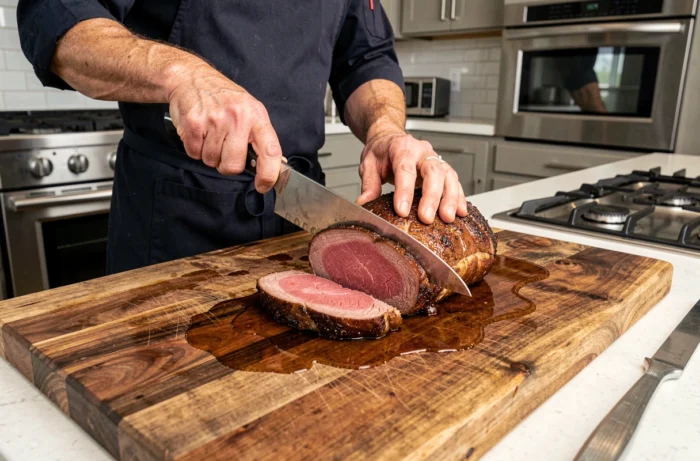
Reheating a Beef Roast in the Oven: The Method that Protects Moisture
Take the roast out of the refrigerator about twenty minutes before reheating. Starting at room temperature reduces thermal shock and limits the abrupt contraction of muscle fibers, which expels the juice.
Aluminum Foil as a Humid Enclosure
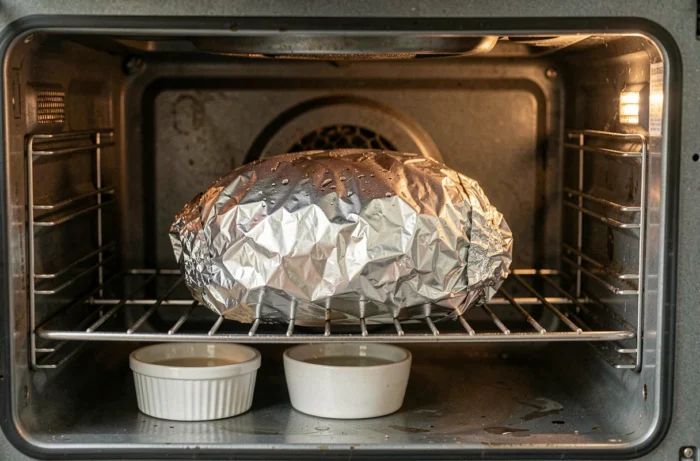
Wrapping the piece in aluminum foil creates a sort of mini-steamer. The steam released by the meat remains trapped, and the dry air of the oven does not come into direct contact with the surface. Add one or two tablespoons of broth, cooking juice saved from the day before, or simply water to the bottom of the packet before sealing. This liquid turns into steam and maintains a high humidity level around the meat.
Set the oven to around 120 °C in convection mode. The temperature rise remains gradual, allowing the fibers to relax rather than contract. Place the packet on the middle rack and monitor the probe.
When to Open and When to Serve
As soon as the probe indicates that the core has exceeded the safety threshold, turn off the oven and let the meat rest in the closed packet for a few minutes. This resting redistributes the juices inside the piece, just like after the first cooking. Opening the packet too early means losing all the accumulated steam and exposing the surface to rapid drying.
Feedback varies on the exact time depending on the thickness of the piece and the type of oven, but the thermometer remains the only reliable judge.
Reheating in a Pan with Juice: The Solution for Slices
For already sliced pieces, the oven is less suitable. The exposed surface is too large compared to the volume of meat, and drying occurs quickly. The pan offers more direct control.
Heat a pan over medium heat with a drizzle of oil or a knob of butter. Place the slices without overlapping, then immediately pour in one or two tablespoons of broth or sauce. Cover with a lid. The lid traps the steam and turns the pan into a mini-braiser.
Reheating takes little time. Turn the slices only once, check that they are hot at the core, and serve immediately. Every extra second on the heat dries out the meat. The key action: remove the pan from the heat slightly before the slices look perfect, as the residual heat will finish the job.
Concrete Mistakes that Ruin the Tenderness of Reheated Roast
We have all made at least one of these mistakes. Identifying them allows us to avoid them systematically.
- Reheating in a very hot oven (over 180 °C) to save time. The fibers contract violently and expel all the water. The meat goes from tender to rubbery in just a few minutes.
- Reheating in the microwave without protection or added liquid. Microwaves agitate the water molecules in the meat, which evaporate directly. Without a lid or added moisture, the microwave dries out faster than any other method.
- Slicing the roast before storing it in the refrigerator. The larger the exposed surface, the more moisture the meat loses during storage and reheating. Keeping the whole piece intact as long as possible protects the core.
- Forgetting to add a liquid (broth, sauce, cooking juice, water) regardless of the reheating method. This liquid compensates for evaporation and provides protective steam.
Sauce and Accompaniment: Recovering Lost Juiciness
Even with a careful method, a reheated roast will never be as juicy as when it first came out of the oven. A generous sauce compensates for this deficit and adds fat, moisture, and flavor.
The cooking juice saved from the day before is the best base. Heat it separately in a small saucepan, adjust the seasoning, and pour it over the slices at the time of serving. If there is no juice, a reduced broth with a spoonful of mustard and a bit of cold butter whipped in makes for a quick and effective accompaniment.
Coating the slices at the last moment rather than letting them soak in the sauce during reheating helps maintain a clean texture on the surface while adding the necessary moisture for the palate.
A properly reheated beef roast will not replace the magic of the first cooking, but it can offer a very decent meal. Thermometer probe, packet, added liquid, and patience: four elements that make the difference between tender slices and meat that no one finishes.