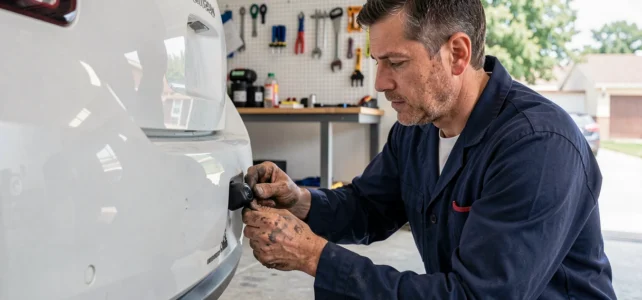
Installing a rearview camera on a Citroën C3 involves choosing between several types of kits, various connection methods, and different receiving screens. The choice of equipment directly affects the installation difficulty, image quality, and compatibility with the vehicle’s electronics. This guide analyzes the available options for different generations of the C3, taking into account a parameter often overlooked: software recall campaigns that can affect the camera display.
Citroën C3 Rearview Camera: Comparison of Available Kit Types
The market offers three main categories of kits to equip a C3. Each involves different levels of difficulty, budget, and compatibility with the original screen or an aftermarket radio.
| Kit Type | Screen Connection | Cable Routing | Original Screen Compatibility | Installation Difficulty |
|---|---|---|---|---|
| Wired camera with license plate mount | RCA video cable to radio or dedicated screen | From the rear plate to the dashboard | No (unless adapter module) | Medium to high |
| Wireless camera (transmitter) | Wireless receiver connected to the screen | Local power only | No (unless adapter module) | Low to medium |
| OEM or manufacturer-compatible kit | Direct connection to the NAC/RCC multimedia system | Original harness or pre-wiring | Yes | Medium (software coding required) |
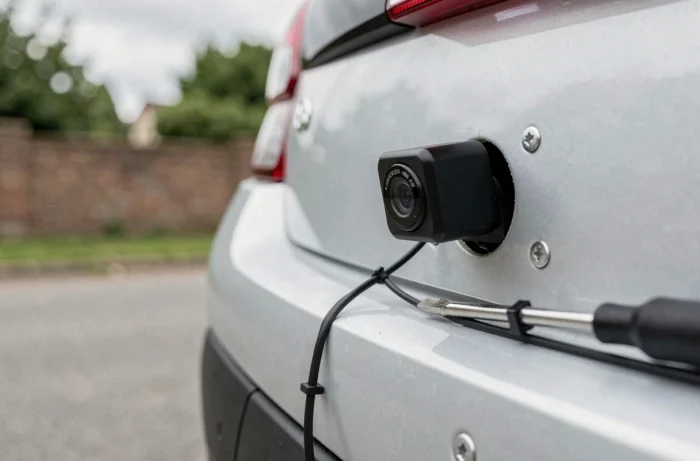
The wired camera with license plate mount remains the most common solution on first and second generation C3s. It offers a stable image with no latency but requires running a video cable the entire length of the vehicle. The routing is generally done under the side trims of the trunk, along the sill, and then under the dashboard.
Wireless kits simplify cable routing by replacing the video cable with a transmitter. However, they can generate interference, especially near parking sensors or other onboard electronic equipment.
For C3s equipped with an original touchscreen (NAC or RCC system), a manufacturer-compatible kit allows the image to be displayed directly on that screen. This option requires software coding via a diagnostic tool, which represents an additional cost if the operation is entrusted to a professional. A detailed guide on the installation of a rearview camera for Citroën C3 outlines the specific steps for recent models, including the electric version.
Stellantis Recalls and Software Bugs: Check Before Installing
Before diagnosing a mounting issue or investing in a new kit, it is essential to rule out a software cause. This is an angle that most tutorials overlook, even though it directly affects recent C3s.
In August 2026, Stellantis launched a recall affecting approximately 955,000 vehicles worldwide due to a software malfunction preventing the rearview camera image from displaying on the central screen. This issue follows a similar recall in 2024 for the same type of defect. The fix is deployed via over-the-air software update (OTA), without the need for a mandatory workshop visit.
Additionally, a specific recall targeted around 57,000 Citroën C3 and C3 Aircross produced between April 2024 and early 2025, for electronic anomalies affecting driving aids. These two campaigns mean that a black screen when shifting into reverse is not necessarily a wiring defect or a faulty camera.
- Check the manufacturer’s website or contact a dealer to verify if your C3 is affected by an ongoing recall
- Check the software version of the multimedia system (NAC or RCC) before any hardware intervention
- Test the existing camera after an OTA update if the vehicle is eligible, before purchasing a replacement kit
Viewing Angle, Waterproofing, and Video Signal: Criteria for Choosing a Camera for Citroën C3
The viewing angle of a rearview camera determines the area covered behind the vehicle. For a C3, whose rear window is relatively narrow, a camera with a wide angle compensates for limited visibility. Most aftermarket models offer an angle between 120 and 170 degrees. Beyond 150 degrees, barrel distortion increases at the edges of the image, which can complicate distance assessment with obstacles.
Waterproofing is a criterion often underestimated. A camera mounted on the license plate holder is directly exposed to water splashes, mud, and de-icing salt. The IP67 standard ensures sufficient protection for an outdoor installation. An IP65 standard, acceptable in theory, allows more moisture to enter over the long term.
The type of video signal also deserves attention. Analog cameras in NTSC or PAL signal remain compatible with the vast majority of aftermarket radios. AHD (Analog High Definition) cameras offer better resolution but require a compatible AHD screen or radio. Connecting an AHD camera to a standard RCA input produces a blurry image, which is a common source of confusion during the first test.
Electrical Connection and Automatic Activation on Citroën C3
The electrical connection of a rearview camera relies on two distinct circuits: the power supply for the camera and the trigger signal.
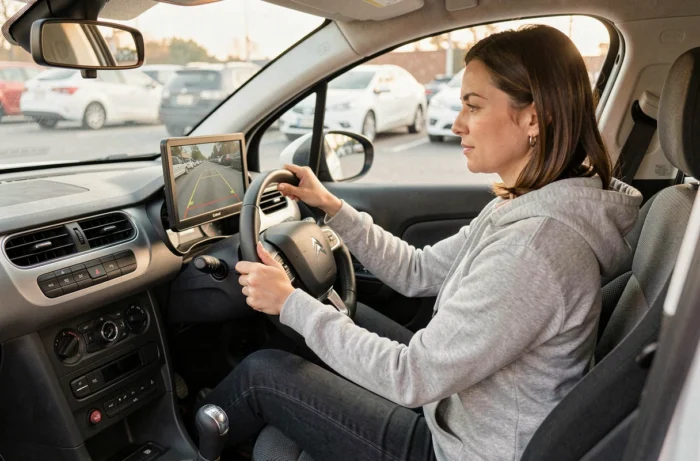
The power is taken from the reverse light wire, located at the rear light cluster. This wire provides current only when the reverse gear is engaged, which powers the camera and simultaneously sends a switching signal to the screen to automatically switch to the video input.
- On first generation C3s (2002-2009), the reverse wire is accessible directly behind the left rear light after removing the trunk trim
- On second generation C3s (2009-2016), the rear light connector is accessible via the same route, but the harness is sometimes more closely bonded to the body
- On third generation C3s (from 2016), the multimedia system may require additional coding to recognize the camera input, even if the physical wiring is correct
A technical point not to be overlooked: the polarity of the reverse wire must be checked with a multimeter before any connection. A polarity reversal will not damage the camera in most cases, but it will prevent the automatic triggering of the display.
On C3s equipped with parking sensors, the audible signal from the sensors and the camera image complement each other. The two systems remain electrically independent, but their simultaneous activation when shifting into reverse provides more comprehensive coverage of nearby and distant obstacles.
The choice between a personal installation and a workshop installation mainly depends on the generation of the vehicle. For C3s built before 2016, installation remains accessible with common tools and a sufficiently long video cable. For newer models, the software coding of the multimedia system represents the most technical step, and the one that most often justifies a visit to a professional equipped with a compatible Stellantis diagnostic tool.